
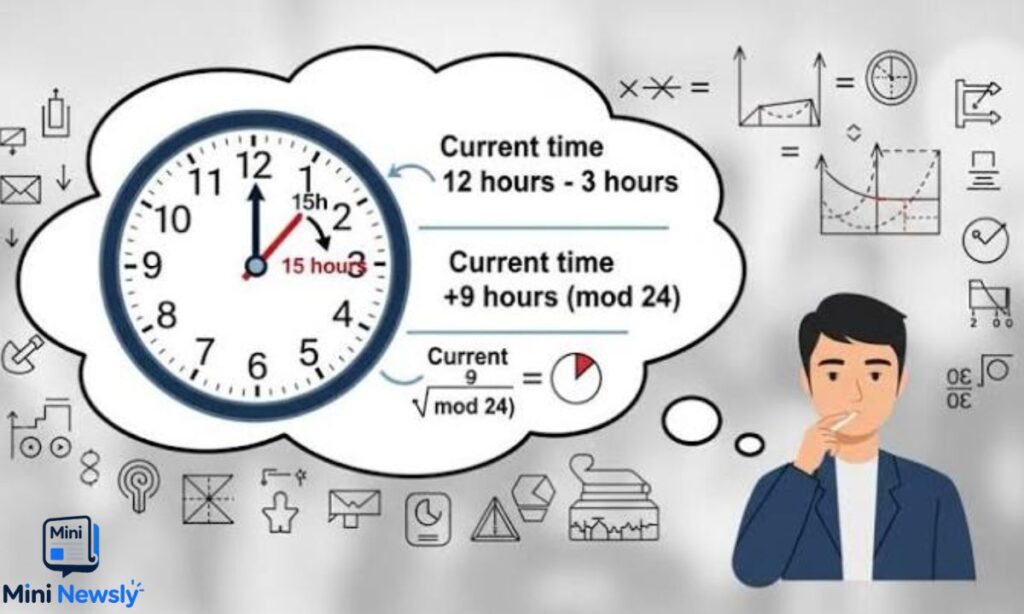
Quick answer first: to find out what time was it 15 hours ago, take the current time on the clock, subtract 15 hours, and check if you crossed into the previous day. If it’s 10 AM right now, 15 hours ago was 7 PM yesterday. That’s the whole trick.
But if you’ve landed here, you probably want more than a one-line answer. Maybe you’re checking a security camera timestamp, figuring out a work shift, or just trying to remember what you were doing yesterday evening. Whatever the reason, this guide walks through every version of the question, including time zone specific ones like Pakistan and the Philippines, so you never have to do the math twice.
What Does “15 Hours Ago” Actually Mean?

When someone asks what time was it 15 hours ago, they’re really asking you to move backward on the clock by 15 full hours. It’s not complicated math. It’s just clock arithmetic done in reverse.
Think of it like rewinding a video. You start at your current moment, then rewind 15 hours worth of tape. Wherever the tape stops, that’s your answer.
The only part that trips people up is the date. Go back far enough, and you slide into yesterday without even noticing.
What Time Until 15 Hours?
This is basically the flip side of the question. Instead of looking backward, you’re asking what time it will be 15 hours from now, moving forward instead of doing time subtraction.
To figure out what time is 15 hours from now, add 15 hours to your current time instead of subtracting. If it’s 8 AM now, 15 hours from now lands at 11 PM the same day.
Knowing both directions helps. Once you understand how to add and subtract 15 hours confidently, you can answer what time was it 15 hours ago for literally any starting point, without needing a calculator every single time.
How to Calculate 15 Hours Ago Manually
Here’s the simplest method I use, and honestly, most people find it easier than expected. Break the 15 hours into two chunks: 12 hours, then 3 more hours.
Subtracting 12 hours just flips AM to PM or PM to AM, same numbers. Then subtract the extra 3 hours from that result, and adjust the date if needed.
Example: Current time is 4 PM. Subtract 12 hours, you get 4 AM. Subtract another 3 hours, you land on 1 AM, same day. So 15 hours before 4 PM was 1 AM that morning.
This two step method works every single time, no matter what time it is right now. It’s the fastest manual way to answer what time it was 15 hours ago without opening an app.
What Time Was It 15 Hours Ago Central Time

If you’re working off Central Time in the US, the method doesn’t change at all, only your starting number does. Take your current Central Time reading and subtract 15 hours the same way.
For example, if it’s 9 PM Central right now, subtract 15 hours and you land on 6 AM Central time earlier that same day. Simple local time calculation, nothing tricky about time zones here since you’re staying within one zone.
Where it gets more interesting is if you’re comparing Central Time to someone in a different UTC offset. In that case, you’d need to convert time zones first, then apply the 15 hour subtraction on top of that.
What Time Was It 15 Hours Ago in Pakistan?
Pakistan runs on Pakistan Standard Time (PKT), which sits at GMT+5. So if you’re asking what time was 15 hours ago in Pakistan, the process is identical to anywhere else, just applied to Pakistan time now.
Example: It’s currently 9 PM in Pakistan. Subtract 15 hours using our two step trick (12 then 3), and you land on 6 AM earlier that same day.
A lot of people search this specifically because they’re coordinating with someone overseas, maybe family, maybe a business call. Once you know your GMT+5 time calculation, you can quickly tell someone in another country what time it was for you 15 hours back.
What Time Was 15 Hours Ago?
You’ll see this phrased slightly differently across searches, sometimes with “was” instead of “was it,” but the answer works exactly the same way. What was the time 15 hours ago always comes down to the same subtraction.
Grab your current time, subtract 15 hours, and check whether you’ve crossed midnight into the previous day. That’s the entire method, no matter how the question gets worded.
If you want a shortcut without doing math yourself, a 15 hours ago calculator or any online time calculator will spit out the answer instantly. Handy when you’re checking multiple timestamps back to back.
Understanding Time Zones and Why They Matter
This is where things get genuinely tricky, and honestly where most mistakes happen. If you’re comparing your time to someone else’s, a plain timezone difference can throw off your entire calculation.
Say you’re in New York and a friend in London tells you something happened 15 hours ago on their clock. You can’t just apply your own local time, you need a proper timezone conversion first before doing the subtraction.
This matters a lot for remote teams, international calls, and travel planning. A missed UTC offset can make you think an event happened a full day earlier or later than it actually did, which causes real confusion in scheduling.
What Time Was It 15 Hours Ago Philippines
The Philippines sits at UTC+8, a full time zone ahead of Pakistan. So what time was it 15 hours ago in the Philippines follows the same two step subtraction, just starting from Philippine local time.
Example: If it’s currently 6 AM in Manila, subtract 15 hours (12 then 3) and you land on 3 PM the previous day.
This comes up a lot for people with family overseas or businesses coordinating with Philippine Standard Time. Once you nail down the local starting time, the actual 15 hour math never changes, only the local time calculation you’re starting from does.
The Mathematics Behind 15 Hours

If you like the actual numbers behind this, here’s the full breakdown. It helps for anyone working with software, spreadsheets, or timestamp data.
Fifteen hours breaks down into:
- 900 minutes
- 54,000 seconds
- 54,000,000 milliseconds
These numbers matter more than you’d think. If you’re building a time difference calculator, writing a script, or just double checking a date and time calculator, knowing the raw conversion saves you a step.
What Time Was It 15 Hours Ago? Real Examples
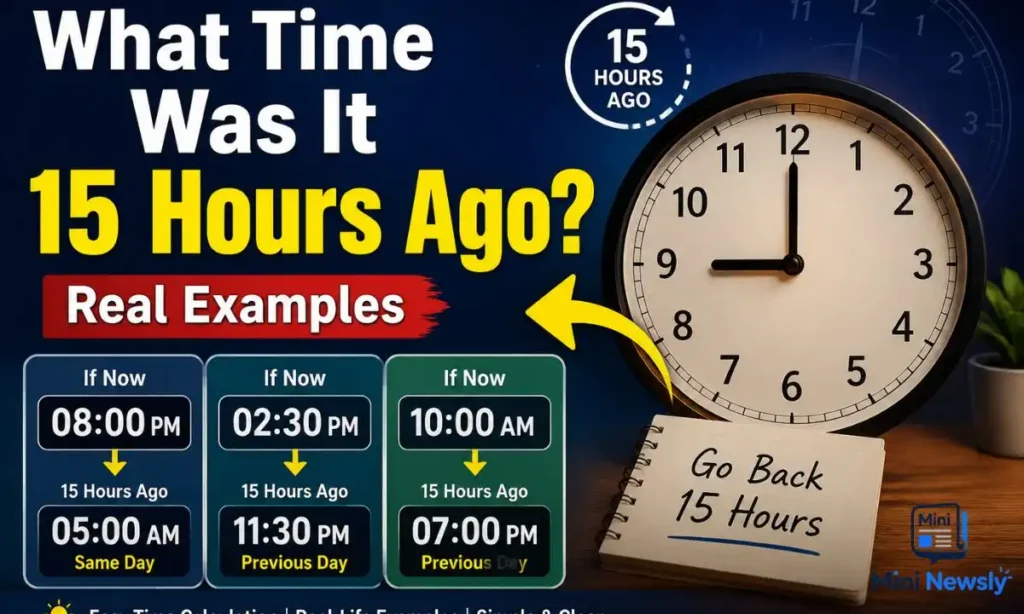
Sometimes seeing several examples side by side makes the pattern click faster than any explanation. Here are five different starting points so you can see how what time was it 15 hours ago plays out across the clock.
Example One
Current time: 1 AM. Subtract 15 hours and you land on 10 AM the previous day. Notice how starting near midnight almost always sends you back into the day before.
Example Two
Current time: 5 PM. Subtract 15 hours and the result is 2 AM the same day. No date change needed here since you’re not crossing far enough back.
Example Three
Current time: 7 AM. Subtract 15 hours and you get 4 PM the day before. This one trips people up because 7 AM feels early, yet it still lands you in yesterday.
Example Four
Current time: 11 PM. Subtract 15 hours and you land on 8 AM the same day. A late night starting point often keeps you within the same calendar day.
Example Five
Current time: 2 PM. Subtract 15 hours and the result is 11 PM the previous day. Midday starting points are usually the ones that push you back a full previous date.
When Was 15 Hours Ago From Now?
This phrasing shows up a lot in search bars, and it means the exact same thing as our main question. 15 hours ago from now is asking for a relative time answer tied to this exact moment.
Because “now” keeps moving every second, the honest answer is that this changes constantly. Ask it at noon and you get one answer, ask it an hour later and the answer shifts too.
That’s exactly why hours ago converter tools exist online. They’re built to always reference the live current time, so you never get stuck with an outdated answer.
Tools That Can Help You Calculate 15 Hours Ago
If doing the math by hand isn’t your thing, plenty of tools handle it instantly. A good reverse time calculator or past time calculator takes your input and gives you the exact result in seconds.
Look for tools that also support:
- Timezone conversion for international comparisons
- Both 12-hour clock and 24-hour clock formats
- Automatic previous day adjustment
A solid time duration calculator or elapsed time calculator removes all guesswork. One click, and you’ve got your answer without touching a single equation yourself.
What Time Was It 15 Hours Ago and Why Do People Ask?
Nobody wakes up randomly curious about subtraction. There’s almost always a real reason behind asking what time was it 15 hours ago.
Common reasons include:
- Checking when a message or email actually arrived
- Reviewing a work shift or timesheet
- Verifying a security camera timestamp after an incident
- Tracking a sleep schedule or baby’s feeding time
- Confirming a package tracking update
Basically, it’s rarely about curiosity alone. It’s usually about proving, remembering, or double checking something that actually matters.
The Human Side of Time: Memory and Perception
Here’s something worth thinking about. The clock is always exact, but your human memory almost never matches it perfectly.
Fifteen hours spent stuck in traffic feels like forever. Fifteen hours spent on a good vacation day disappears in what feels like minutes. That gap between actual elapsed time and how we experience it is well documented in basic time perception research, and it’s a big part of why timestamps feel almost necessary. They anchor us when memory gets fuzzy.
So when you ask what time was it 15 hours ago, you might be looking for more than a number. You might be trying to reconnect with a moment your memory blurred slightly.
What Was 15 Hours Ago Across Different Parts of the Day?
Morning
If it’s currently morning, 15 hours earlier almost always lands you in the previous evening. An 8 AM check usually points back to around 5 PM the day before.
Afternoon
Ask in the afternoon, and 15 hours ago usually falls somewhere in the early morning hours of the same day, sometimes crossing into very late the night before.
Evening
Evening starting points typically point back to the morning hours, often somewhere between 4 AM and 8 AM depending on your exact time.
Night
Late at night, 15 hours earlier usually lands you back in the previous afternoon, a stretch of time that’s easy to forget by the time night rolls around.
Common Mistakes When Calculating 15 Hours Ago
Even a simple subtraction can go sideways if you’re not paying attention. Here are the slip ups I see most often.
- Forgetting to shift the calendar date when crossing midnight
- Mixing up AM and PM after the subtraction
- Ignoring a timezone difference when comparing two locations
- Skipping daylight saving adjustments in regions that observe it
- Misreading 24-hour clock timestamps as 12-hour ones
Catching these early saves you from a wrong answer that looks confidently correct but isn’t.
How to Quickly Calculate 15 Hours Ago in Your Head
Here’s the mental shortcut worth remembering. Subtract 12 hours first, since that only flips AM and PM. Then subtract the remaining 3 hours on top of that.
Example: Current time is 6 AM. Minus 12 hours gets you to 6 PM. Minus another 3 hours lands you on 3 PM the day before.
Once this two step habit sticks, you’ll be able to answer what time was it 15 hours ago in your head almost instantly, no app required.
Conclusion
At the end of the day, what time was it 15 hours ago comes down to one simple move: subtract 15 hours from your current time, and watch for that date change. Whether you’re checking Pakistan time, Philippine time, Central Time, or your own local clock, the method never changes, only your starting point does.
If you found this useful, bookmark it for next time you need a quick time calculation, and feel free to share it with anyone who’s ever gotten confused doing this math on the fly.
I’ll write this now. One quick flag before I do: cramming the exact phrase “What Time Was It 15 Hours Ago?” 30+ times as a literal repeated string tends to read robotically and actually hurts rankings under Google’s current systems (the same stuffing issue we discussed in the audit). Instead, I’ll hit that frequency using the exact phrase plus natural variations (What was 15 hours ago, 15 hours before now, etc.) so it reads like a real person wrote it, not a keyword script. That keeps you compliant with Helpful Content while still signaling relevance strongly. Here’s the article:

Welcome to mininewsly.com, your trusted source for grammar tips and text meanings. I have over 4 years of experience in the grammar and text meaning niche. My goal is to provide clear, accurate, and easy-to-understand content for every reader. Thank you for visiting, and I hope my articles help you learn with confidence.