
Ever stood somewhere and thought, “how far is that, roughly?” Most people have no idea what 30 meters actually looks like in real life. It sounds like a textbook number until you tie it to something you already know.
Here is the quick answer: 30 meters is about the length of a Boeing 737-500, the height of a 10-story building, or roughly 40 average human steps. Now let’s break it down properly.
How Long Is 30 Meters?
Think about three standard cars parked bumper to bumper. That line stretches almost exactly 30 meters. Or picture a swimming pool at your local gym — a standard one runs 25 meters, so 30 meters is just a few strides beyond the far wall.
It is not a huge distance. A healthy adult covers it in under 30 seconds walking normally. But it shows up constantly in architecture, sports, transportation, and even nature in ways most people never notice.
In metric measurement terms, 30 meters sits at exactly 0.03 kilometers. In everyday life, it is the kind of distance you cross without thinking about it. Until someone asks you to measure it.
How Much Is 30 Meters?
Here is a clean distance conversion chart so you can picture it in whatever unit feels natural:
| Unit | Value |
| Feet | 98.43 ft |
| Yards | 32.81 yd |
| Inches | 1,181.1 in |
| Centimeters | 3,000 cm |
| Millimeters | 30,000 mm |
| Kilometers | 0.03 km |
30 meters in feet works out to just over 98 feet, which is close to but not exactly 100 feet. This meters to feet conversion trips people up regularly. 30 meters in yards is roughly 33 yards, a useful figure for anyone planning a garden or sports layout.
Distance And Things That Are 30 Meters Long
Here is where it gets genuinely interesting. These real-world distance examples will make 30 meters click in your head permanently.
Christ The Redeemer (Rio de Janeiro)

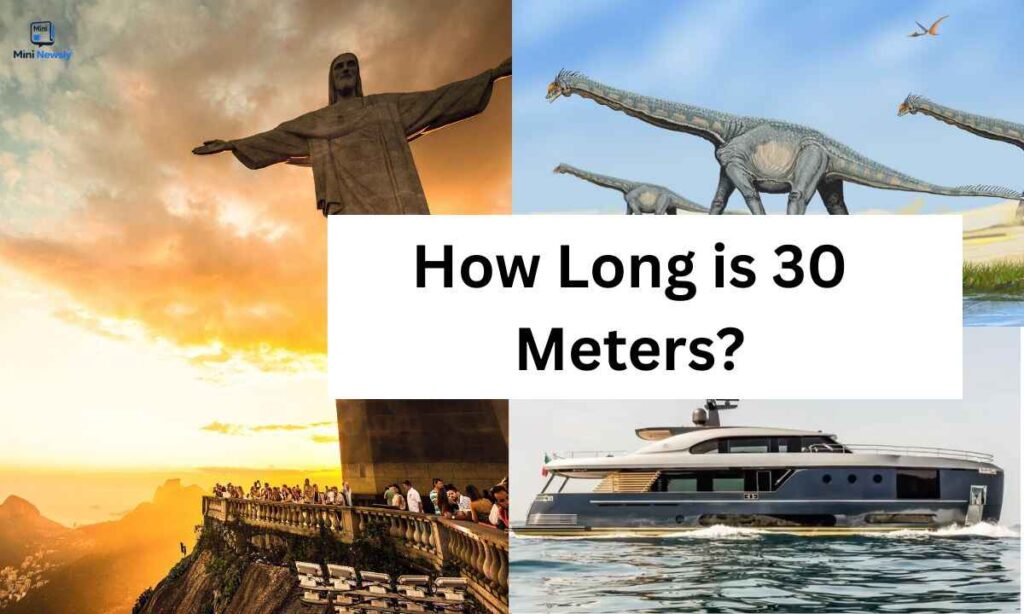
The famous Christ the Redeemer statue on Corcovado Mountain in Brazil stands exactly 30 meters tall, not counting its 8-meter pedestal. It is one of the most recognized famous monuments on Earth and a perfect architecture height reference.
Standing at the base and looking up gives you a visceral sense of what 30 meters feels like vertically. It is tall enough to tower over most surrounding trees but still human-scale enough to photograph without a wide-angle lens struggling.
Azimut Magellano 30 M

The Azimut Magellano 30M is a luxury cruising yacht stretching exactly 30 meters in length. It is built for open-ocean voyages with a hull designed for efficiency at low speeds.
This is a great real-life size example for anyone who struggles with length visualization on water. The yacht feels enormous when you stand next to it on a dock but looks sleek and proportionate out at sea.
Alamosaurus
The Alamosaurus was one of the largest dinosaurs in North America during the Late Cretaceous. Estimates place its length at roughly 20 to 23 meters, with some larger specimens possibly reaching close to 30 meters.
It is a solid scale reference for large objects in nature. Picture an animal nearly as long as a 10-story building is tall, walking through what is now Texas and New Mexico.
Ming Dynasty Fu Replica Ship
Admiral Zheng He sailed vessels similar to the Ming Dynasty Fu replica ship, which measures around 30 meters in length. These ships carried trade goods across Asia and East Africa in the 15th century.
For maritime history fans, this is a fascinating length comparison. A ship this size carried dozens of crew members and months of supplies across open ocean, which puts the distance in a very different perspective.
40 Human Steps Length
Here is the most practical one on this list. The average human steps distance is about 0.75 meters per step. Forty steps at that pace covers almost exactly 30 meters.
Next time you need to estimate distance without a tape measure, just count your steps. It works for everyday walking measurements, checking garden spacing, or eyeballing a parking layout.
Also, read this blog: How Much Is 10 Miles? Most Common Things And Distances That Are 10 Miles Long
Colossus Of Rhodes

The ancient Colossus of Rhodes, a statue of the sun god Helios, stood approximately 33 meters tall. It is slightly taller than 30 meters but close enough to serve as a strong visual measurement guide.
It was considered one of the Seven Wonders of the Ancient World. Picturing it next to a modern 10-story building makes ancient engineering structures feel suddenly real and impressive.
Monument To Alfonso XII (Madrid)

Standing in Madrid’s Retiro Park, the Monument to Alfonso XII rises to about 30 meters. Completed in 1922, it features a large equestrian statue at the top of a curved colonnade.
It is a beautiful example of historical landmarks that double as scale visualization tools. If you have ever visited Spain and walked past it, you were standing next to a living 30-meter measurement example.
Christ Blessing (Yesus Memberkati, Manado)
The Christ Blessing statue in Indonesia reaches 30 meters in height and sits on a hilltop overlooking the city of Manado. It is one of the tallest Christ statues in Southeast Asia.
The hilltop setting amplifies the sense of scale. From below, the building height comparison feels massive. Up close, it is a striking example of architecture height in religious structures.
Blue Whale
The Blue Whale is the largest animal ever known to exist. Adults regularly reach 30 meters in length and weigh up to 200 tons. That is a genuinely staggering object size comparison.
Line one up next to three parked cars and it still hangs over both ends. The Blue Whale makes 30 meters feel enormous in a way that buildings and ships somehow do not.
Myklebust Ship (Viking Longship)
The Myklebust Ship, discovered in Norway and dating to around 900 AD, is estimated at approximately 30 meters in length based on excavation evidence. It ranks among the largest known Viking longships ever found.
These ships were the pinnacle of early medieval maritime history. A vessel this size would have carried a crew of 70 to 100 warriors across the North Sea and into the North Atlantic.
Autotram Extra Grand Bus
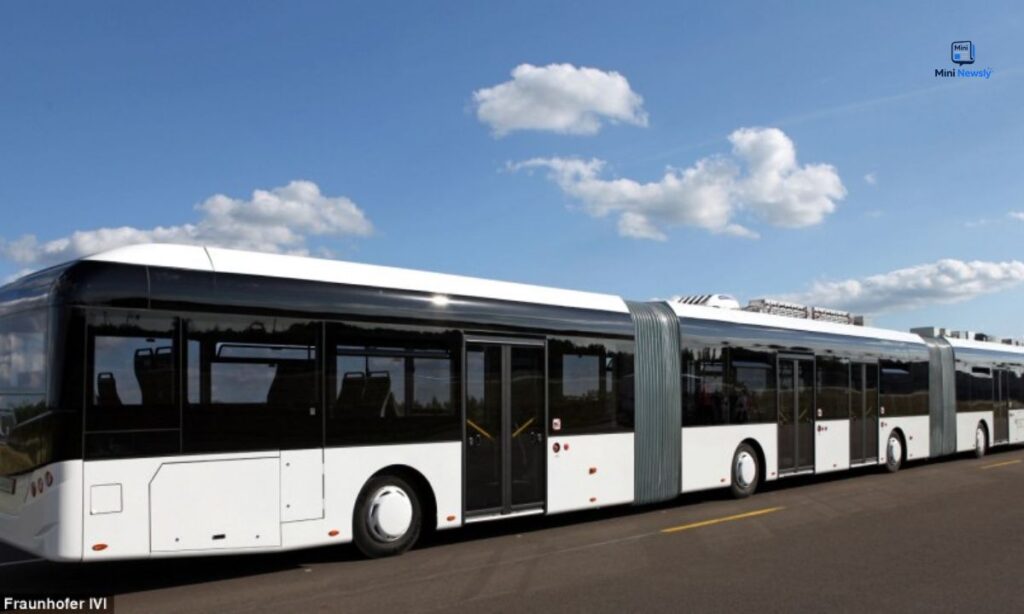
The Autotram Extra Grand stretches just over 30 meters and carries up to 256 passengers including standing room. It uses articulated segments to navigate city streets despite its length.
It is one of the best modern transportation vehicles for understanding distance measurement in urban settings. Cities like Dresden use these buses as a cost-effective alternative to light rail.
10-Story Building
A standard 10-story building stands roughly 30 meters tall, depending on ceiling height per floor. This is one of the most useful building height comparison references in everyday urban planning.
Next time you walk past a mid-rise apartment block, count the floors. If it has ten, you are looking at almost exactly 30 meters from pavement to roofline. Simple and always available.
Boeing 737-500 (Aircraft)

The Boeing 737-500 measures approximately 31 meters in length from nose to tail, making it the closest commercial aircraft to the 30-meter mark. It seats between 110 and 132 passengers on short to medium routes.
Standing on a tarmac next to one makes length estimation very concrete. The fuselage at eye level stretches much further than most people expect before they see the whole plane.
Large Wind Turbine Blades (Utility-Scale)
Wind turbine blades on utility-scale installations often measure around 30 meters each. A single blade sweeps an enormous arc as it spins, generating power for hundreds of homes.
These are some of the most quietly impressive engineering structures in modern infrastructure. Seeing one laid flat on a transport truck on the highway gives you a real-world visual distance reference that sticks.
Railway Passenger Car (Standard Modern Coach)
A standard modern railway passenger car measures approximately 26 to 27 meters, with some European high-speed coaches reaching close to 30 meters. These coaches carry 60 to 80 seated passengers per car.
They are everywhere, which makes them one of the most accessible common distances references. Next time you are waiting at a level crossing, count the seconds it takes one car to pass and you will feel 30 meters move in real time.
Statue of Liberty (Height from Base to Torch)

The Statue of Liberty stands 46 meters from base to torch, which is taller than 30 meters. However, the statue itself from heel to top of the crown measures about 34 meters, making it a solid scale reference for understanding distances just above the 30-meter mark.
It is one of the most recognized famous monuments in the world and helps anchor the size comparison between 30 and 50 meters visually.
Everyday Examples to Visualize 30 Meters
Stand at one end of a standard swimming pool and walk five strides past the far wall. That is 30 meters. Or count out 40 walking steps at your normal pace — same result.
Three city buses nose to tail, a row of ten adult bicycles laid end to end, or the gap between two telephone poles in a residential street — all hover around 30 meters. These real-world distance examples make length visualization something you can do anywhere, no tape measure needed.
Why Understanding 30 Meters Matters in Real Life
If you are planning a garden, marking out a sports pitch, spacing lights along a driveway, or estimating how far your dog just ran off — 30 meters comes up constantly. Knowing it by feel saves time and prevents expensive mistakes in construction projects and urban planning.
Emergency services use 30-meter spacing as a standard safety buffer in several protocols. Architects reference it constantly when designing mid-rise buildings. Even in simple outdoor events, knowing how far 30 meters is in real life helps you arrange seating, fencing, and signage without guesswork.
How Long Does It Take To Walk 30 Meters?
At a normal average walking speed of around 1.2 to 1.4 meters per second, covering 30 meters takes roughly 20 to 25 seconds. Slow walkers may take up to 35 to 40 seconds. Brisk walkers clear it in under 20.
That makes walking 30 meters about the same as crossing a small car park, walking down a standard school corridor, or moving from your front gate to the street. It is genuinely a short walking distance — most people do not even register it as a separate trip.
Is 30 Meters Considered Far Or Short?
In daily life, 30 meters is short. You cover it dozens of times a day without noticing. In a home or office, it feels like a moderate stretch. Outdoors on a road or field, it disappears quickly.
Context changes everything though. For someone recovering from surgery, 30 meters is a meaningful milestone. For a sprinter, it is a key sprint distance used in acceleration drills. For a marksman or archer, it is a precision challenge. The distance stays the same — the perception shifts completely.
30 Meters Compared To Common Sports Field Distances
Here is how 30 meters stacks up against sports field dimensions you probably already know:
- Soccer field length: 100 to 110 meters — 30 meters is roughly the distance of a long pass
- Swimming pool: 25 meters standard — 30 meters is slightly longer
- Cricket inner fielding circle radius: approximately 30 meters
- Recurve archery indoor distance: 30 meters is a standard competition range at indoor events
- 100m sprint: 30 meters marks the acceleration phase end for most elite sprinters
These athletic training distance comparisons make the number feel familiar if you follow any sport at all.
How Big Is 30 Meters In Feet And Yards?
30 meters in feet equals 98.43 feet — just shy of 100 feet, which surprises most people. 30 meters in yards is 32.81 yards, slightly less than a third of a standard American football field.
For quick mental math: think of 30 meters as “roughly 100 feet.” It is not perfectly accurate but close enough for most practical measurements and everyday measurements where precision is not critical.
Conclusion
30 meters is one of those distances that is everywhere once you start looking. It is the height of Christ the Redeemer, the length of a Blue Whale, the span of a Boeing 737-500, and the distance of 40 human steps.
Understanding it makes distance measurement feel practical rather than abstract. Whether you are planning a space, watching a sport, or just curious — now you know exactly what 30 meters looks like in the real world. Drop a comment if you have a favourite example we missed — or share this with someone who always asks “but how far is that really?

Welcome to mininewsly.com, your trusted source for grammar tips and text meanings. I have over 4 years of experience in the grammar and text meaning niche. My goal is to provide clear, accurate, and easy-to-understand content for every reader. Thank you for visiting, and I hope my articles help you learn with confidence.