
Have you ever looked at the clock and thought, “wait, what time was it 12 hours ago?” Maybe you are checking a call log, tracking a flight, or just trying to figure out when something actually happened. Whatever the reason, this question pops up more often than you would expect.
The good news is that answering what time it was 12 hours ago is one of the simplest time calculations you can do. You do not need a math degree. You just need a clock, a bit of logic, and two minutes.
This guide walks you through the exact steps, gives you real examples, and shows you how a time calculator makes the whole thing effortless. By the end, you will never have to second guess this question again.
What Time Was It 12 Hours Ago? Understanding the Core Idea of Time Shift
At its core, figuring out what time it was 12 hours ago is about shifting your current time backward by half a day. That is it. There is no trick hiding underneath.
Think of a full day as having two equal halves. One half runs from midnight to noon. The other runs from noon to midnight. So when you subtract 12 hours from any moment, you are simply jumping to the opposite half of that same day cycle.
This is why people call it a half day calculation. If it is currently 3:00 PM, the opposite half of the day is 3:00 AM. Same number, flipped period. That single rule solves almost every version of this question, including any time you ask yourself what time was it 12 hours ago in the middle of a busy day.
What time was 12 hours ago
The direct answer depends only on your current time. Take the clock time right now, keep the number the same, and flip AM to PM or PM to AM.
For example, if the current time is 8:45 PM, then 12 hours ago it was 8:45 AM. If it is 6:10 AM right now, then 12 hours ago it was 6:10 PM yesterday. Notice how the minutes never change. Only the AM and PM label swaps.
Here is a quick reference table so you can check different starting points without doing any math yourself.
| Current Time | Time 12 Hours Ago |
| 12:00 AM (midnight) | 12:00 PM (noon) |
| 3:30 AM | 3:30 PM (yesterday) |
| 9:15 AM | 9:15 PM (yesterday) |
| 12:00 PM (noon) | 12:00 AM (midnight) |
| 4:20 PM | 4:20 AM |
| 11:59 PM | 11:59 AM |
This table works for any day, any month, and any year. The logic never changes because a 12 hour clock always repeats itself in two identical loops, which is exactly why what time was it 12 hours ago always has one clean, predictable answer.
What time was it 12 hours from now
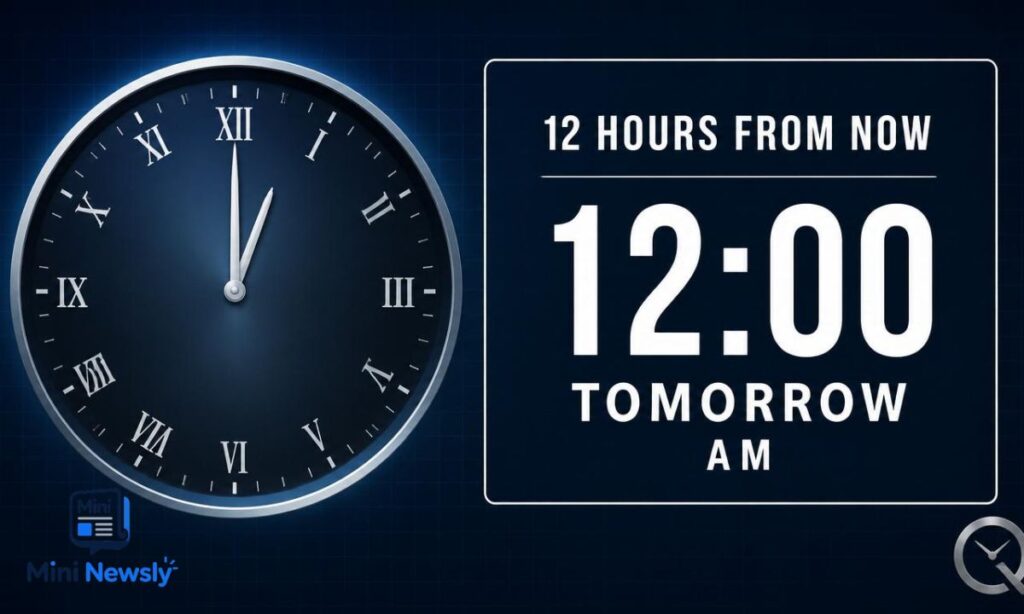
This is basically the mirror image of the earlier question. Instead of looking backward, you look forward by adding 12 hours instead of subtracting them.
The rule stays exactly the same, just reversed. Keep the minutes fixed and swap AM to PM or PM to AM. If it is currently 1:00 PM, then 12 hours from now it will be 1:00 AM the next day.
People often ask this when planning something like a flight landing, a work shift, or a deadline. Knowing both directions, past and future, gives you a complete picture of your daily time offset. It also helps when you are double checking plans across a time zone or comparing schedules with someone in another country.
Understanding this forward version also makes the backward version easier. Once you know how to add 12 hours, working out what time it was 12 hours ago becomes almost automatic, since both directions rely on the exact same swap.
What Time Was It 12 Hours Ago? Step-by-Step Time Calculation Guide
If you like doing things manually instead of relying on an app, here is the exact process for figuring out what time it was 12 hours ago. It only takes three small steps.
- Write down the current time. Include the AM or PM label so you do not lose track later.
- Subtract 12 from the hour number. If subtracting makes the number go below 1, add 12 back to it. For example, 5 minus 12 becomes 5 plus 12, which is 17. Since we only use the 12 hour format, this equals 5, but the label flips.
- Swap AM and PM. This single swap is really the entire secret behind the whole calculation.
Let’s run through a full example together. Say it is currently 7:25 AM on a Wednesday. Subtract 12 hours and the number 7:25 stays exactly the same. Flip AM to PM, and you get 7:25 PM the previous day.
This same three step method works for time subtraction involving any hour, whether you are checking a digital clock or reading an analog clock on the wall. Once you practice it a couple of times, answering what time it was 12 hours ago becomes second nature.
What time was it 12 hours ago est
If you are working with Eastern Standard Time (EST), figuring out what time was it 12 hours ago does not change at all. You still keep the minutes the same and flip AM to PM or PM to AM. The only difference is that you are applying the rule inside the EST time zone specifically.
For instance, if the current time in EST is 2:40 PM, then 12 hours ago in EST it was 2:40 AM. This is useful for people tracking calls, emails, or transactions tied to businesses running on EST, since a lot of financial and news reporting in the United States uses this time zone as a reference point.
One helpful tip is to always note the date and time together, not just the clock reading. Since subtracting 12 hours often pushes you into the previous calendar day, mixing up the date can create confusing timestamps, especially in reports or logs.
What Time Was It 12 Hours Ago in GMT+5: A Local Time Reflection
GMT+5 is the time zone used in places like Pakistan Standard Time (PKT), and the same simple rule applies here too when working out what time it was 12 hours ago. Take the current local time, keep the minutes untouched, and swap AM to PM.
So if it is currently 9:00 PM in GMT+5, then 12 hours ago it was 9:00 AM in that same region. This matters a lot for people juggling international calls, remote work schedules, or online meetings that stretch across different world clock zones.
A small but important detail here is daylight differences. GMT+5 does not typically observe daylight saving changes, so the offset usually stays consistent throughout the year. That makes calculations in this zone a little more predictable compared to regions that shift their clocks twice a year.
What time was it 12 hours ago yesterday
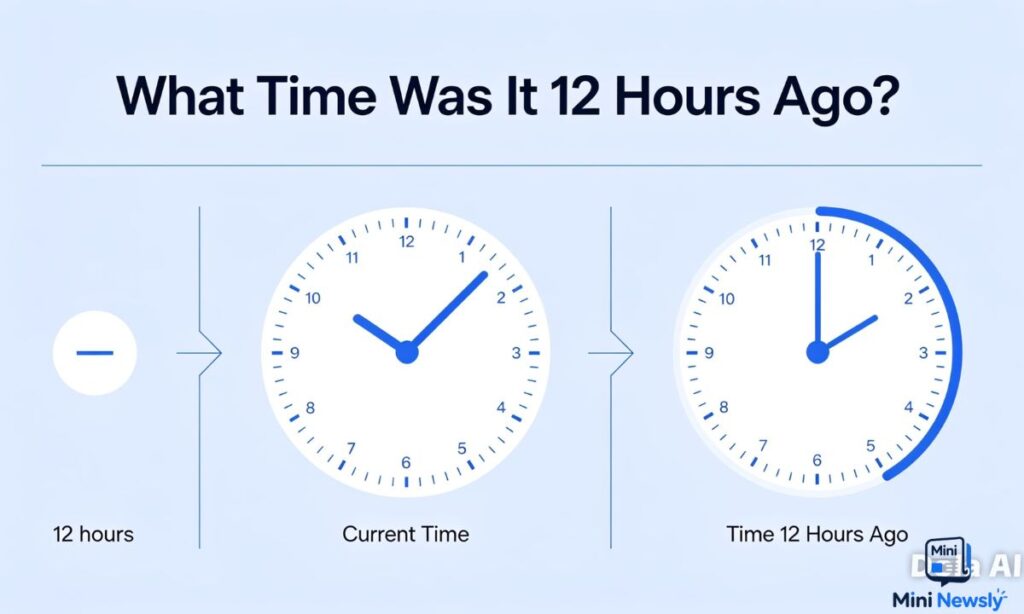
This phrase usually comes up when someone is trying to line up an event that happened the day before. Asking what time it was 12 hours ago yesterday follows the exact same math, you just need to be extra careful about which date you land on.
Let’s say today is Wednesday, and the current time is 4:15 AM. Twelve hours before that lands you at 4:15 PM, but on Tuesday, which is technically yesterday relative to today. This is the part that trips people up the most, not the hour, but the previous day calculation.
A simple trick is to ask yourself one question first: is the current time before noon or after noon? If it is before noon, your 12 hour shift almost always lands on the previous calendar day. If it is after noon, it usually stays on the same day. Keeping this mental checkpoint saves a lot of confusion.
Also read this Blog: How Long Until 3:30 PM? Check the Exact Countdown Instantly (2026)
Tools, Calculators, and the Modern Way of Thinking About Time
While manual math works fine, most people prefer using an online time calculator for speed and accuracy. A good hours ago calculator answers what time was it 12 hours ago instantly, removing any chance of human error, especially when you are dealing with time zone conversion across countries.
These tools typically ask for your current time and time zone, then instantly show the result. Many also double as an elapsed time calculator, letting you check how much time has passed between two specific moments instead of just a flat 12 hour shift.
Here are a few features worth looking for in a solid time difference calculator:
- Support for both 12-hour clock and 24-hour clock formats
- Automatic AM and PM conversion
- Options to switch between different time zones
- Ability to calculate milliseconds conversion for extremely precise timing needs
- A clean interface that shows both the previous time and the current one side by side
If you deal with time arithmetic often, bookmarking a reliable calculator saves a surprising amount of daily hassle.
Common Mistakes in Subtracting 12 Hours
Even though this calculation is simple, people still trip up on it fairly often when working out what time it was 12 hours ago. Knowing the common mistakes ahead of time helps you avoid them completely.
Mistake one: forgetting to flip AM and PM. This is the single biggest error. People subtract correctly but forget the label swap, which throws the entire answer off by a full 12 hours.
Mistake two: ignoring the date change. As mentioned earlier, crossing midnight often shifts you into the previous day. Skipping this detail creates a wrong timestamp even if the clock number itself is right.
Mistake three: mixing up time zones. If you are working across regions, forgetting to convert first can lead to a completely wrong result. Always confirm whether you are calculating in UTC, EST, GMT+5, or your own local time before doing the subtraction.
Why the 12-Hour Clock System Still Confuses People
The 12-hour clock has been around for centuries, yet it still causes mix ups today, which is part of why so many people search for what time was 12 hours ago instead of working it out on their own. Part of the reason is that noon and midnight do not follow the usual counting pattern you would expect.
Most people assume midnight should be labeled 0 AM and noon should be 0 PM, but instead both are labeled as 12. This small inconsistency is where a lot of confusion begins, especially for anyone doing quick mental time conversion.
The 24-hour clock, sometimes called military time, avoids this issue entirely since every hour has a unique number from 0 to 23. That is part of why hospitals, airlines, and the military often prefer it. Still, everyday life in many countries continues to rely on the 12-hour clock, so understanding its quirks remains genuinely useful.
A Small Cultural Glimpse Into Time Thinking
Time might feel like a fixed, universal thing, but different cultures actually approach it in slightly different ways, and even the way people ask what time it was 12 hours ago can reflect that. Some regions place heavy importance on noon as the center of the day, while others treat midnight as the true starting point of a new one.
In many South Asian countries, including areas that follow Pakistan Standard Time (PKT), daily routines are often built around prayer times and daylight patterns rather than strict clock numbers. This slightly changes how people mentally calculate a half day calculation compared to places where work shifts define the day instead.
Understanding this cultural layer is not just trivia. It genuinely helps when you are scheduling international meetings or trying to be considerate of someone else’s daily rhythm instead of only thinking about your own local time.
Real World Examples of What Time Was It 12 Hours Ago
Sometimes the best way to understand a concept is to see it in action. Let’s look at a few everyday situations where asking what time it was 12 hours ago actually matters.
Imagine you are reviewing a security camera log and it shows an event at 11:00 PM. If someone asks what time it was 12 hours ago from that timestamp, the answer is simple: 11:00 AM that same day. This kind of check is common in workplaces, warehouses, and even home security systems.
Another example: a friend calls you and says they landed at 6:30 AM. You want to know what time was it 12 hours ago relative to their landing, maybe to check when they boarded. The answer is 6:30 PM the night before, which likely lines up with their departure time.
Here is one more. Say you are reading a server log stamped 12:05 AM and need the corresponding time from 12 hours earlier. Using the same rule, what time was it 12 hours ago in that case is 12:05 PM the previous day. Small examples like these show why this calculation shows up constantly in real life, not just as a random trivia question.
Quick Math Behind the Scenes
For those who enjoy the numbers side of things, here is a fun breakdown behind what time was it 12 hours ago. Twelve hours equals 720 minutes, which breaks down further into 43,200 seconds. If you go even deeper, that becomes a fairly large number of milliseconds, though most people never need that level of precision outside of scientific or technical work.
Knowing these numbers is not essential for daily use, but it does help explain why a time duration calculator is so handy for anything requiring exact precision, like lab experiments or software timestamps.
Timestamps, Formulas, and Digital Time Tools
If you work with computers or apps, you have probably run into a current timestamp or a past timestamp somewhere in a log file. These are just precise records of a moment in time, often shown in something called ISO time format, which lists the year, month, day, and exact time together.
A timestamp converter can instantly tell you what time was it 12 hours ago based on any timestamp you paste in. This is especially handy for developers, analysts, or anyone dealing with date and time data across different systems.
There is also a basic clock formula behind all of this. Subtract 12 from the current hour, adjust if the number goes below 1, and flip the AM or PM label. That one formula covers every version of the reverse time calculation you will ever need to answer what time was it 12 hours ago for a 12 hour shift.
For anyone who prefers checking things visually, a world clock or world time converter website can show the local time in multiple cities at once. This makes it easy to compare a current local time against a time from 12 hours earlier in a completely different part of the globe.
Conclusion
Figuring out what time it was 12 hours ago really comes down to one simple habit: keep the minutes the same and flip AM to PM or PM to AM. Whether you are checking GMT+5, EST, or your own local time, the logic never changes.
Use the step by step method when you want to do it yourself, or lean on a trusted online time calculator when speed matters more. Either way, you now have everything you need to answer this question confidently, any time it comes up.
If this guide helped clear things up, feel free to bookmark it for next time you find yourself squinting at the clock and wondering what happened 12 hours ago.

Welcome to mininewsly.com, your trusted source for grammar tips and text meanings. I have over 4 years of experience in the grammar and text meaning niche. My goal is to provide clear, accurate, and easy-to-understand content for every reader. Thank you for visiting, and I hope my articles help you learn with confidence.